Difference Between Ethereum And Bitcoin Explained
As difference between ethereum and bitcoin takes center stage, this opening passage beckons readers into a world crafted with knowledge, ensuring a reading experience that is both absorbing and distinctly original.
Bitcoin and Ethereum are two titans of the cryptocurrency realm, each with its unique characteristics and purpose. While Bitcoin is often seen as digital gold, a store of value, Ethereum introduces a revolutionary platform for decentralized applications, enabling smart contracts that expand its utility far beyond mere transactions.
Overview of Bitcoin and Ethereum
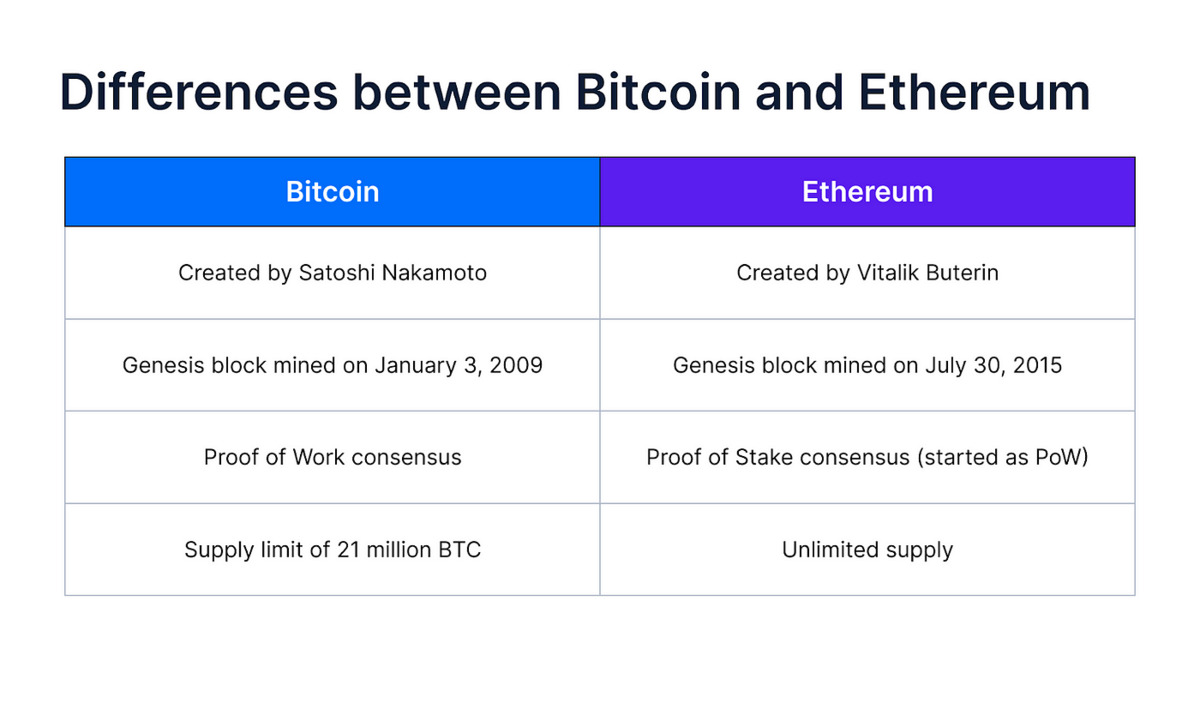
Bitcoin and Ethereum are two of the most prominent cryptocurrencies in the digital economy today. Both have distinct origins and purposes that cater to different aspects of blockchain technology. Bitcoin, introduced in 2009 by an anonymous entity known as Satoshi Nakamoto, was the first cryptocurrency and was created as a decentralized digital currency to facilitate peer-to-peer transactions without the need for a trusted intermediary.
On the other hand, Ethereum, proposed in late 2013 by Vitalik Buterin and launched in 2015, extends the blockchain concept beyond just currency. It allows developers to build decentralized applications (dApps) using smart contracts, which are self-executing contracts with the agreement directly written into code.Historically, Bitcoin paved the way for the cryptocurrency market, gaining significant traction after its initial coin offering (ICO) and subsequent adoption by various online merchants.
Ethereum quickly followed, capturing interest due to its innovative approach to programmable blockchain technology. The primary purpose of Bitcoin is to serve as a digital gold and a store of value, while Ethereum aims to be a platform for decentralized applications and smart contracts, expanding the functionality of blockchain technology.
Technology and Architecture
The blockchain architectures of Bitcoin and Ethereum demonstrate key differences that reflect their distinct purposes. Bitcoin operates on a straightforward design focused on secure and fast transaction processing. It uses a UTXO (Unspent Transaction Output) model which tracks the ownership of Bitcoin. Conversely, Ethereum utilizes an account-based model, allowing for more complex transactions involving smart contracts.Both cryptocurrencies employ unique consensus mechanisms to validate transactions.
Bitcoin relies on the Proof of Work (PoW) algorithm, which requires significant computational power to solve cryptographic puzzles. Ethereum initially operated on PoW as well but has transitioned to Proof of Stake (PoS), which allows users to validate transactions based on the number of coins they hold and are willing to “stake” as collateral.When it comes to transaction speeds and scalability, Bitcoin typically processes transactions every 10 minutes, with a maximum of around 3 to 7 transactions per second.
Ethereum, on the other hand, aims for faster transaction times, averaging around 15 seconds per block, but the actual speed can vary based on network congestion and gas fees.
Use Cases and Applications

The use cases for Bitcoin and Ethereum highlight their roles within the cryptocurrency ecosystem. Bitcoin is primarily used as a digital currency for transactions and a store of value, often referred to as "digital gold." It is utilized for remittances, online purchases, and as an investment asset.Ethereum's versatility enables a wide range of applications to be built on its platform.
From decentralized finance (DeFi) applications that allow users to lend, borrow, and earn interest on their crypto holdings, to non-fungible tokens (NFTs) that represent ownership of unique digital assets, Ethereum's smart contracts facilitate diverse use cases.For instance, Bitcoin transactions often involve straightforward exchanges of value, while Ethereum's smart contracts enable complex agreements, such as automatically executing trades on decentralized exchanges (DEXs) or creating decentralized autonomous organizations (DAOs) that govern themselves through community voting.
Economic Models and Supply
Bitcoin has a capped supply limit of 21 million coins, a feature designed to create scarcity and potentially increase value over time. In contrast, Ethereum does not have a fixed supply cap, allowing for a more flexible issuance model that can adapt to network needs. This difference influences the economic incentives for miners as well; Bitcoin's miners are rewarded with newly minted coins and transaction fees, while Ethereum's transition to PoS will change rewards to include staking incentives.The value of both cryptocurrencies is heavily influenced by supply and demand dynamics.
Bitcoin's fixed supply creates upward pressure on its price during periods of increased demand, while Ethereum's supply model can expand to accommodate greater use, but its value is influenced by transaction fees and network activity.
Community and Governance
The governance structures of Bitcoin and Ethereum reflect their community philosophies. Bitcoin's development is led by a decentralized group of contributors with no formal governance structure, relying on consensus and community agreement for upgrades and changes. Significant proposals often emerge from community discussions, with notable upgrades like Taproot enhancing privacy and smart contract functionality.Ethereum's governance is more centralized, with the Ethereum Foundation and key developers playing a significant role in decision-making processes.
The transition to Proof of Stake, known as Ethereum 2.0, is one of the most significant developments in the Ethereum community, aiming to enhance scalability and sustainability.Community-led initiatives are also present in both ecosystems, such as Bitcoin's adoption within institutional investment sectors and Ethereum’s growing platform for decentralized applications, showcasing the commitment of their communities toward respective missions.
Security and Risks
Bitcoin and Ethereum both implement robust security features, though their approaches differ. Bitcoin's security is rooted in its extensive network of miners and the substantial computational power required to execute attacks. Conversely, Ethereum's security will evolve with its shift to PoS, where the economic stake of validators provides an incentive to act honestly.Investing in both cryptocurrencies carries inherent risks, including market volatility, regulatory scrutiny, and technology-related vulnerabilities.
Common attacks, such as double spending or 51% attacks, pose significant threats to both networks, although they are more challenging to execute on Bitcoin due to its larger network.
Future Trends
The future of Bitcoin and Ethereum is poised for significant developments, shaped by technological advancements and market dynamics. Bitcoin may see further acceptance as a legitimate asset class, especially among institutional investors looking for a hedge against inflation. Ethereum is expected to continue expanding its ecosystem, with the potential for enhanced scalability and reduced transaction costs post-Ethereum 2.0.Emerging trends in the cryptocurrency market, such as increased adoption of DeFi and NFTs, could further influence the trajectories of both cryptocurrencies.
However, challenges such as regulatory uncertainties and competition from other blockchain platforms remain critical factors that could impact their future growth and adoption.
Closure
In summary, understanding the difference between Ethereum and Bitcoin not only enhances your knowledge of the cryptocurrency landscape but also aids in making informed investment decisions. As both continue to evolve, their distinct characteristics will shape their paths in the digital economy.
FAQ Section
What is the main difference in purpose between Bitcoin and Ethereum?
Bitcoin primarily serves as a digital currency and store of value, while Ethereum focuses on enabling smart contracts and decentralized applications.
Which has a fixed supply, Bitcoin or Ethereum?
Bitcoin has a fixed supply limit of 21 million coins, whereas Ethereum does not have a capped supply.
How do transaction speeds compare between Bitcoin and Ethereum?
Ethereum generally offers faster transaction speeds than Bitcoin, making it more suitable for applications requiring quick processing.
What consensus mechanisms do Bitcoin and Ethereum use?
Bitcoin uses a proof of work mechanism, while Ethereum is transitioning to proof of stake, which is expected to improve its energy efficiency.
Are Bitcoin and Ethereum equally secure?
Both have robust security measures, but their different architectures and consensus mechanisms present unique vulnerabilities and strengths.